

Well here is an interesting watch for the collection. A Lanco Autolub 2270. This was one of my “finds” at the August 2021 watch fair in Birmingham UK. I found it in a scrap bucket of watches along with a little Timex (I made a YouTube video on that one) £20.00 for the two watches.
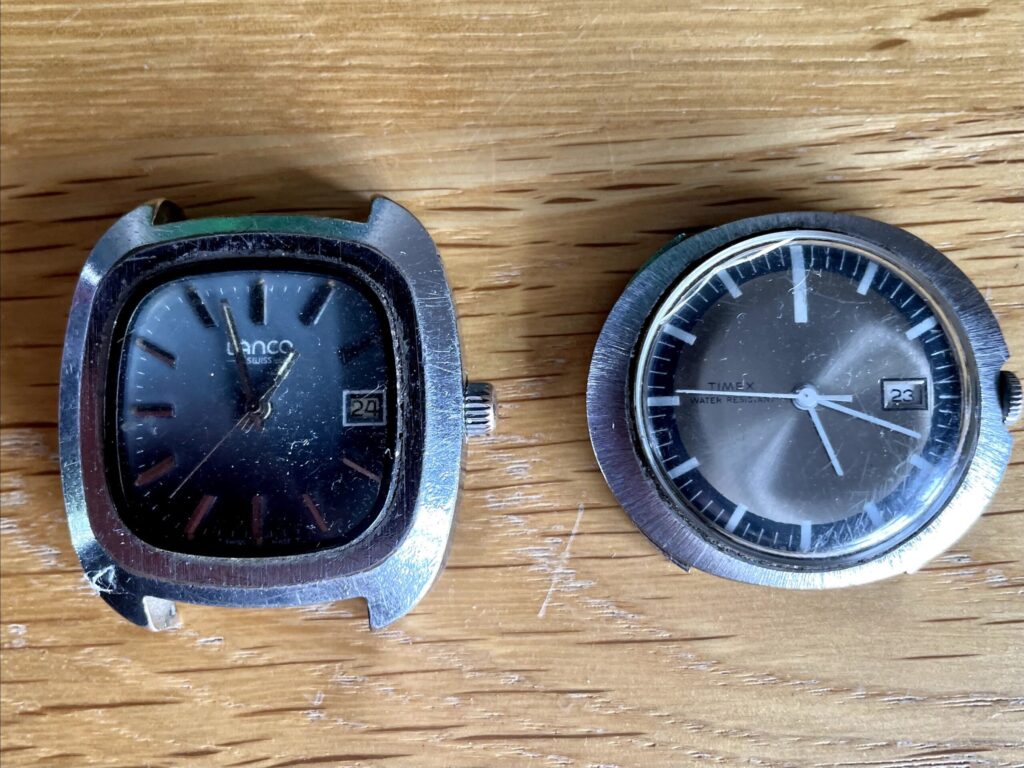
I just liked the look of them and as I had acquired a 1940s Lanco a while ago I thought this could be a hidden little gem. When I got the back off after purchasing I realised that I had picked up the dreaded autolub movement. These are a sealed plastic movement designed and manufactured by Tissot back in the 70s (I believe) The principle behind it was to create a movement that would not need servicing and still be accurate. Using considerable plastic parts and sealing the movement would mean no debris would get inside and no oiling required. Autolub = Auto lubrication.
I believe these were actually a big flop although I do admire the principle behind it and I do like to see watch manufacturers push the boundaries of what can be achieved.
The watch was fully wound yet no power was being transferred to the train of wheels. I have owned a Tissot non runner of these which I flipped back on eBay after looking at it and realising no real work could be done on them.
I took a look at this one and in a half hearted attempt I oiled the showing pivots and poked around with an oiler in the few access holes I could see. What I was able to deduce was that the pallet fork seemed stuck in one direction. This was confirmed when I was able to poke another hole to move the balance wheel. The wheel met with resistance and I immediately knew what the issue was. The pallet fork (a blue plastic one!) was out of position with the impulse pin on the balance wheel. Basically the pin was not inside the fork and thus the watch would not run.
Right time to remove the movement from the case. I could not figure out how to release the stem which frustrated me until it dawned on me that it must be a split stem. I pulled hard on the crown and sure enough it detached from the inner stem. Now the movement was out what could I do?


As you can see from the photos above its plastic fantastic but no real way of entry. fascinating all the same to see a movement like this. I flip the movement over to the dial side and this is where it gets a bit more interesting. I started to remove the calendar works, the hour wheel and a cannon pinion. All made of plastic.


What I then noticed was the balance wheel is outside of the main sealed container and was held in place on posts that looked to be glued. I was able to get a screwdriver under the posts and gently pry off. I had covered the shock spring with Rodico to be sure it would not fly off. The bridge came off leaving the balance wheel exposed enough for me to work on getting the impulse back into alignment.


Getting the balance realigned was easy enough, just a case of lifting it up over the fork and then dropping it in place. As soon as it was engaged it was trying to run. Not very successfully without the bridge in place but clearly this would fix it. Once the bridge was back on boom it swung into action really nicely. Here are some video clips and slow motion captures of the movement. Really interesting to see that plastic pallet fork rocking back and forth.
The rest of the rebuild was straightforward given I had hardly removed any parts. So here it is the finished watch and proof that you can actually do some minor work on these movements and potentially get them working again. I have to say this Lanco keeps good time and will now be a part of the collection purely for this plastic fantastic movement.


